Esha Manchanda

Hi! I am Esha, a first year PhD student at the Lee Kong Chian School of Medicine, Nanyang Technological University. I previously completed my Masters in Biomedical Data Science at Nanyang Technological University and graduated with a Bachelors from Ashoka University with a Gold Medal in Computer Science.
I am passionate about improving human health through the confluence of technology and medicine. My research interests lie at the intersection of neurobiology, immunology, mathematical modelling and machine learning.
My PhD research is supervised by Professor Andrew Tan and Dr Tianrong Yeo, and focuses on the analysis of spatial and single-cell omics in multiple sclerosis.
Beyond research, I love running, playing badminton, solo travelling and learning korean!
Selected Work
-
Data-Efficiency with Comparable Accuracy: Personalized LSTM Neural Network Training for Blood Glucose Prediction in Type 1 Diabetes Management
Esha Manchanda, Jialiu Zeng, Chih Hung Lo
PublicationAccurate blood glucose forecasting is essential for automated insulin delivery systems for type 1 diabetes (T1D) management. However, two people can have completely different blood glucose dynamics under identical exogenous conditions, and current systems do not account for the unique disease patterns of a single individual. In this work, we built personalised blood glucose prediction models to address the inherent inter-patient variability in people with T1D. We find that personalised models trained on substantially less individual data achieve predictive accuracy comparable to models trained on aggregated multi-patient datasets, highlighting the potential for data-efficient, privacy-preserving, and adaptive glucose prediction systems tailored to individual physiology.
-
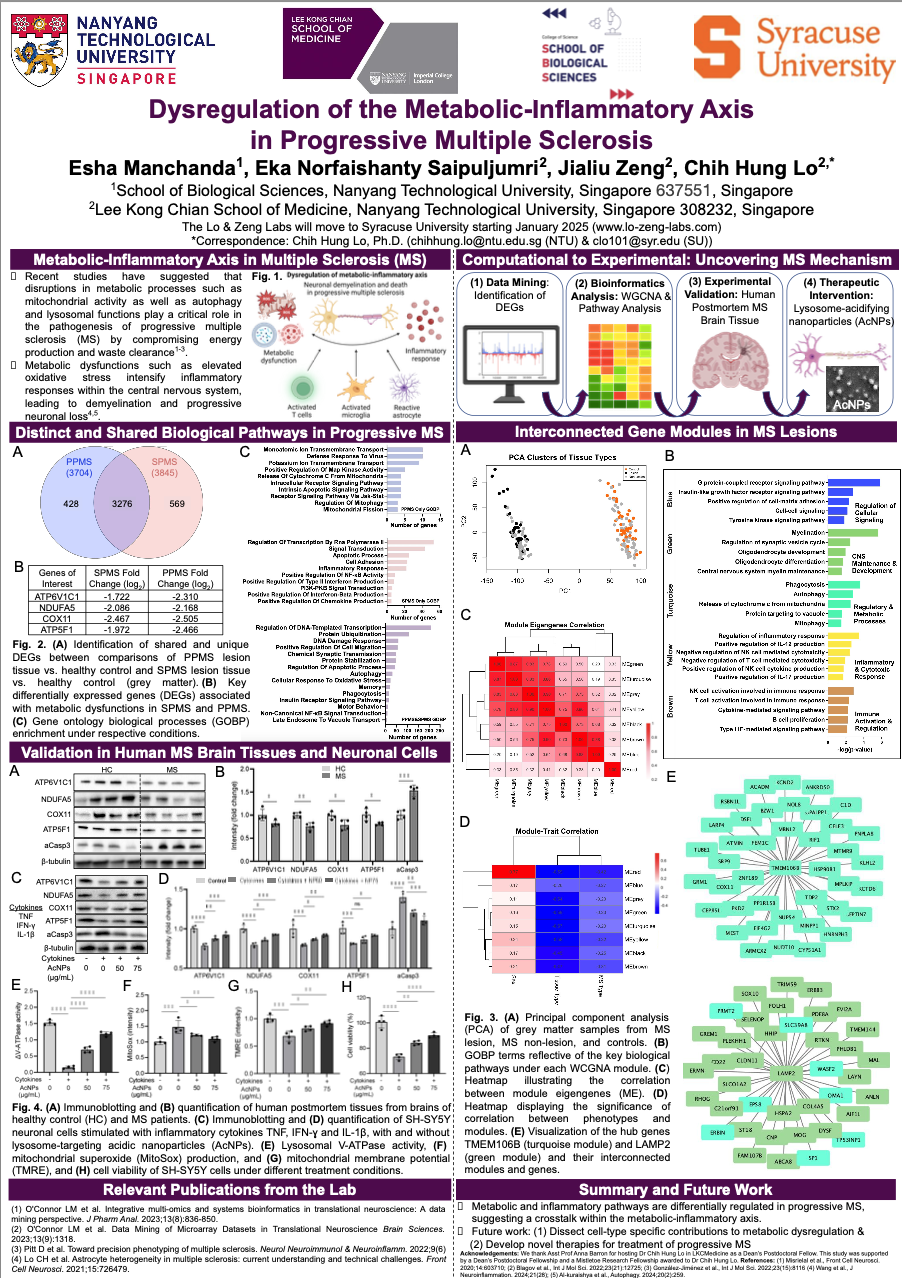
Dysregulation of the Metabolic-Inflammatory Axis in Progressive Multiple Sclerosis
Esha Manchanda, Eka Saipuljumri, Jialiu Zeng, Chih Hung Lo
Poster
Presented as a talk and poster at SSBBI & Neuroscience Singapore 2024Metabolic impairments are shown to be implicated in the pathogenesis of neuroinflammatory diseases such as MS, and therapies aimed at enhancing metabolic functions could potentially attenuate neuroinflammation and open new avenues for treatment of progressive MS. In this study, we investigated the role of mitochondrial, autophagic, and lysosomal dysfunction in progressive MS, exploring their interconnected roles in driving neuroinflammation and neurodegeneration.
-
Exploring the Epstein-Barr Virus-Multiple Sclerosis Link Through A Mathematical Model of Immune Response DynamicsManuscript
In my undergraduate thesis, I explored the relationship between the Epstein-Barr Virus (EBV) and Multiple Sclerosis. Through a mathematical modeling approach, my work studies the potential link between EBV and MS, closely examining the immune system's response to EBV infection. It investigates the role of T-cell exhaustion in uncontrolled EBV lytic activity in B cells, leading to chronic inflammation and potentially the development of MS.
-
Model Agnostic Meta Learning For Disease Prediction From Metagenomic Data
In this work, I applied Model-Agnostic Meta-Learning (MAML) and few-shot learning to predict disease states from gut microbiome metagenomic profiles. The MAML model successfully generalized to new disease classification tasks with limited training samples and outperformed conventional neural networks.
Teaching
I really enjoy teaching, and inspired by my many great teachers, I adopt a constructivist teaching style—where I focus on guiding students to construct knowledge rather than passively absorb information.
Teaching Assistantships
-
Deep Learning for Biomedical Science (Sem 1 AY 2025-26), Nanyang Technological University
Taught by Professor Keng-Hwee Chiam | Course Content
-
Introduction to Computer Programming (Spring 2022), Ashoka University
Taught by Professor Subhashis Banerjee | Course Content -
Computational/Mathematical Biology (Monsoon 2021, Spring 2024), Ashoka University
Taught by Professor Sudipta Tung | Course Website
Workshops Conducted
-
IEEE Ashoka PySci Computational Biology Workshop (November 2023)
[Hands-on exercise] -
Computer Science Society Tools for Web Scraping (October 2021)
[Code]
-
Deep Learning for Biomedical Science (Sem 1 AY 2025-26), Nanyang Technological University